
How the Karate Belt System Teaches Children About Progress and Goal Setting
Donnie Abel | SEP 19, 2026
karate belt system
kids karate
smart goals for kids
building character for kids
kids martial arts
A karate belt is easy to see.
A child starts with one color, works through a series of skills and challenges, and eventually earns another. For children, that visible progression can be exciting. For parents, however, there is something much more significant happening beneath the surface.
The karate belt system gives children an early, tangible experience with setting goals, measuring progress, receiving feedback, and working toward a larger objective over time.
Those aren't just karate skills.
They're life skills.
The same basic framework appears later in school, athletics, careers, business, and personal development. Whether someone is working toward a college degree, building a business, learning a new profession, or training for a marathon, meaningful accomplishments rarely happen all at once. They happen through a series of smaller, measurable steps.
Karate gives children an opportunity to experience that process while they're young.
The Belt Is the Goal, But the Process Is the Lesson

A child may look at a new belt and think, "I want that."
That's a perfectly natural starting point.
But earning that belt requires the student to work through everything that comes before it. They learn specific techniques, practice movements, develop control, improve their understanding, and demonstrate what they've learned.
The larger goal becomes a collection of smaller goals.
That is an incredibly useful concept to learn.
Instead of simply saying, "I want to get better at karate," a student can begin to understand what getting better actually looks like.
What do I need to learn?
What am I already able to do?
What still needs work?
What should I practice next?
That is the beginning of intentional goal setting.
From a Belt to a SMART Goal
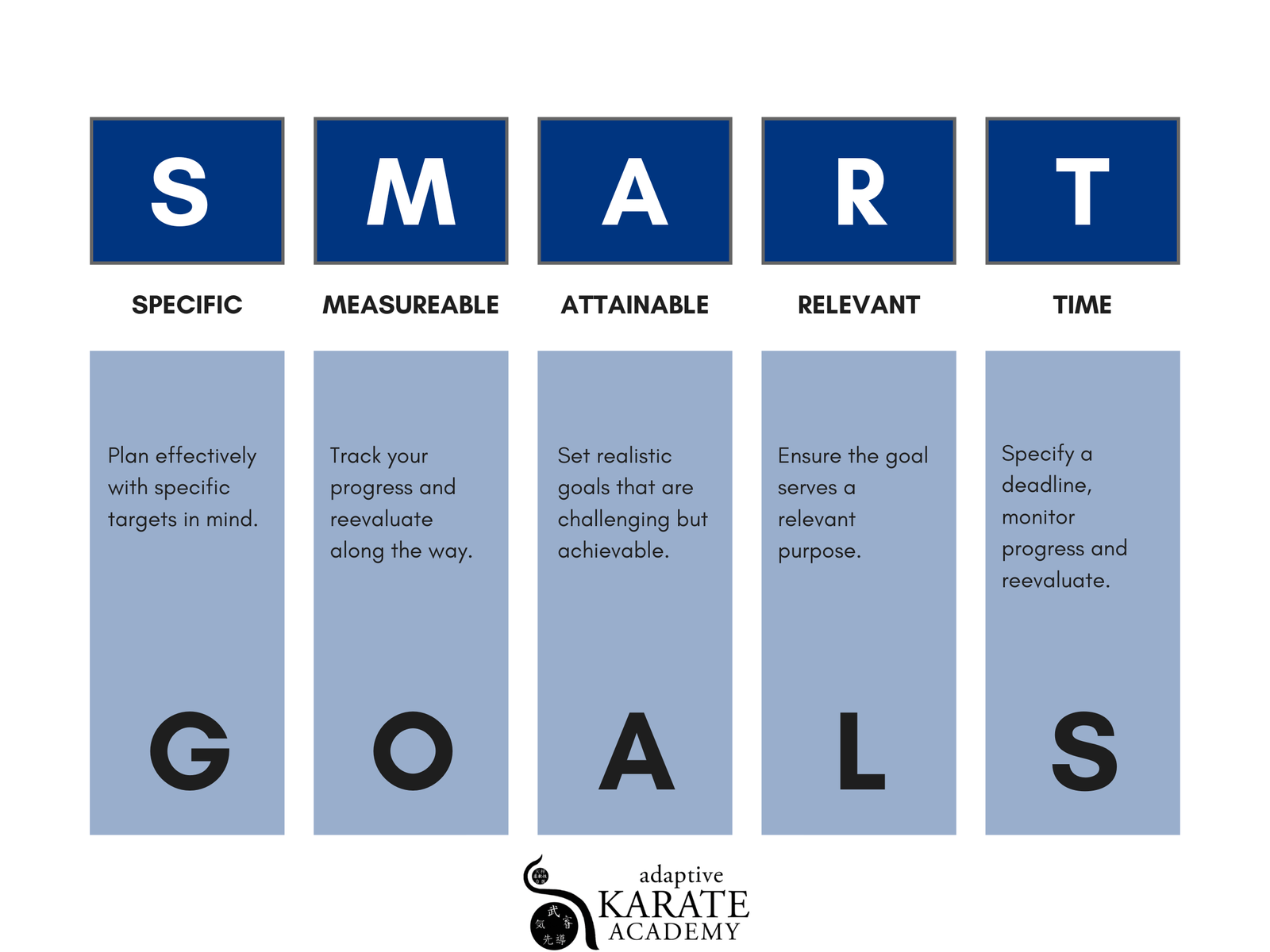
Adults may recognize a similar framework in the concept of SMART goals—goals that are Specific, Measurable, Achievable, Relevant, and Time-Bound.
We use goal-setting frameworks like this in business, education, athletics, and professional development because a large objective can be difficult to act on without a clear path forward.
A karate belt naturally creates an age-appropriate version of that process.
A black belt might be a distant objective for a beginning student. But the student doesn't need to accomplish that goal tomorrow.
Instead, they work toward the next rank.
Within that rank, there are specific skills to learn.
Within those skills, there are individual techniques to practice.
And within those techniques are repetitions—small opportunities to improve.
The child may never sit down and write a formal SMART goal, but they are experiencing many of the same principles:
A larger objective → smaller milestones → measurable progress → feedback → adjustment → achievement.
That experience can become a foundation for how they approach other goals later in life.
Children Need to Be Able to See Progress

One of the challenges of teaching children about long-term goals is that the payoff can feel very far away.
Ask a child to practice something today because it might benefit them months or years from now, and the connection can be difficult to grasp.
The belt system makes progress visible.
A child can physically see that they have moved from one stage of their training to another.
That doesn't mean the belt itself is the measure of a student's worth or ability. Rather, it provides a tangible marker of a particular point in their development.
And those markers matter.
They help children connect effort with progress.
A student can look back at an earlier belt and recognize that something that once felt difficult has become familiar. They can compare where they started with where they are now.
That is a powerful realization:
"I wasn't able to do this before. Now I can."
Progress Is Rarely Linear
Another valuable lesson is that progress doesn't always happen at the same pace.
Some techniques come quickly. Others require considerably more practice.
A student may feel confident one week and frustrated the next. They may encounter a skill that takes longer to master than they expected.
That is where the belt system can become particularly meaningful.
The objective doesn't change simply because one part of the journey is difficult.
The student receives instruction, practices, makes adjustments, and continues working toward the next milestone.
This is much closer to how meaningful goals work in the real world.
Businesses miss projections. Students struggle with difficult subjects. Athletes have setbacks. Professionals encounter skills that take longer to develop than expected.
Progress doesn't require everything to go according to plan.
It requires the ability to evaluate where you are, identify what needs improvement, and determine what comes next.
The Belt System Creates a Feedback Loop

One of the most valuable parts of structured progression is feedback.
Students aren't simply practicing indefinitely and hoping they're improving. Their instructors observe their development and provide guidance about what they're doing well and where they can continue to improve.
That creates a cycle:
Practice → Feedback → Adjustment → Improvement → Progress
This is a pattern that adults use constantly.
An entrepreneur reviews business metrics and adjusts strategy.
A student receives a test grade and identifies areas to study.
An employee receives feedback and develops a new skill.
An athlete reviews performance and changes their training.
Karate gives children an early opportunity to experience that process in a structured environment.
Learning to Work Toward Something You Can't Have Yet
There is also something valuable about the delayed gratification built into a belt system.
A student cannot simply decide that they want the next belt and receive it immediately.
They have to work toward it.
That requires patience.
It also creates an opportunity to understand that wanting an outcome and earning an outcome are two different things.
The goal provides direction. The work creates progress.
And eventually, the student gets to experience the satisfaction of reaching something they once had to wait for.
That experience can change how a child thinks about future goals.
Instead of seeing an accomplishment as something that simply happens, they begin to understand the connection between preparation, consistency, and results.
The Belt Becomes a Record of Growth

Years later, a black belt can represent far more than the techniques required to earn it.
It can represent years of showing up.
Years of learning.
Years of receiving feedback.
Years of working through challenges.
And years of moving from one milestone to the next.
Every belt along the way represents a different point in that journey.
That makes the belt system a physical record of something that is otherwise difficult to see: personal growth over time.
These Lessons Extend Far Beyond the Dojo
The real value of learning to set and pursue goals isn't limited to karate.
As children grow, they'll encounter increasingly complex objectives.
They may want to make a sports team, improve their grades, learn an instrument, apply to college, start a career, or eventually build something of their own.
The goals will become more complicated.
But the underlying process can remain remarkably similar.
Identify the objective.
Determine the steps.
Work consistently.
Measure progress.
Accept feedback.
Adjust when necessary.
Keep moving toward the next milestone.
Karate gives children an opportunity to practice that process in a setting where the progress is concrete and visible.
The Next Belt Is More Than a New Color
For a child, earning a new belt is exciting. It should be.
It's a moment to celebrate the work they've put in and the skills they've developed.
But for parents, it can also be an opportunity to recognize something deeper.
The belt is teaching children that large accomplishments are built through smaller ones.
That goals become more manageable when they are broken into steps.
That feedback is part of improvement.
That progress can be measured.
And that meaningful results usually require consistent effort over time.
Those lessons will continue to matter long after a particular belt has been replaced by the next one.
Building Skills for the Next Goal

At Adaptive Karate Academy, we believe martial arts can give children more than physical skills. A structured progression system gives students opportunities to develop confidence, discipline, goal-setting skills, and an understanding of what it means to work toward meaningful progress.
Every belt is another milestone—but perhaps more importantly, it's another opportunity for a child to discover what can happen when they set a goal and work toward it.
Interested in learning more about Adaptive Karate Academy?
Contact us to learn about our programs and find the right place to begin or register here:
https://www.adaptivekarateacademy.com/offering_packages
Donnie Abel | SEP 19, 2026
Share this blog post


© 2026 Adaptive Karate Academy